
Compliance & Testing
European Compliance Guide for Water Leisure Products & Pools
Similar-looking inflatable water products can follow very different compliance routes in Europe. A children’s swim ring, a baby swim seat, a large pool float and an above-ground pool may all be built from flexible PVC film with HF-welded seams — and still be classified, documented and tested differently.
For a product placed on the European market, the starting point is not the test report and not a list of standard numbers. The starting point is product classification: what the product is, who it is intended for, and how it is meant to be used.
The order that works is: product → intended use → user group → design and configuration → classification → applicable legal and standard route → chemical and material requirements → buyer protocol → factory quality control.
One material. Different compliance routes.
Aquatic toy → EN 71 direction
Swimming learning device → EN 13138 direction
Floating leisure article → EN ISO 25649 direction
Pool classification → EN 71-8 / EN 16927 / EN 16582 direction
The applicable route depends on what the product is intended to do — not simply on whether it is inflatable or made from PVC.
Aquatic Toys: The EN 71 Direction
Products intended primarily as playthings for children in and around water can fall within the toy route. The framework is set by the Toy Safety Directive 2009/48/EC, and the EN 71 series carries the technical requirements a laboratory applies:
- EN 71-1 — mechanical and physical properties
- EN 71-2 — flammability
- EN 71-3 — migration of certain elements
How an aquatic toy behaves in water, how it is inflated, and the warnings and instructions printed on the product and its packaging all feed into the assessment, and age grading decides which parts of the standard are applied to the sample.
Not every inflatable product used in water is an aquatic toy. Intended use, age grading, product design and how the product is presented all matter when the route is decided.
Swimming Learning Devices: The EN 13138 Direction
Products classified as swimming learning devices follow a different safety route from aquatic toys. Depending on design and intended use, body-worn buoyancy aids such as inflatable arm bands sit in the EN 13138-1 direction, while a device the child is fitted into — a baby swim seat — sits in the EN 13138-3 direction.
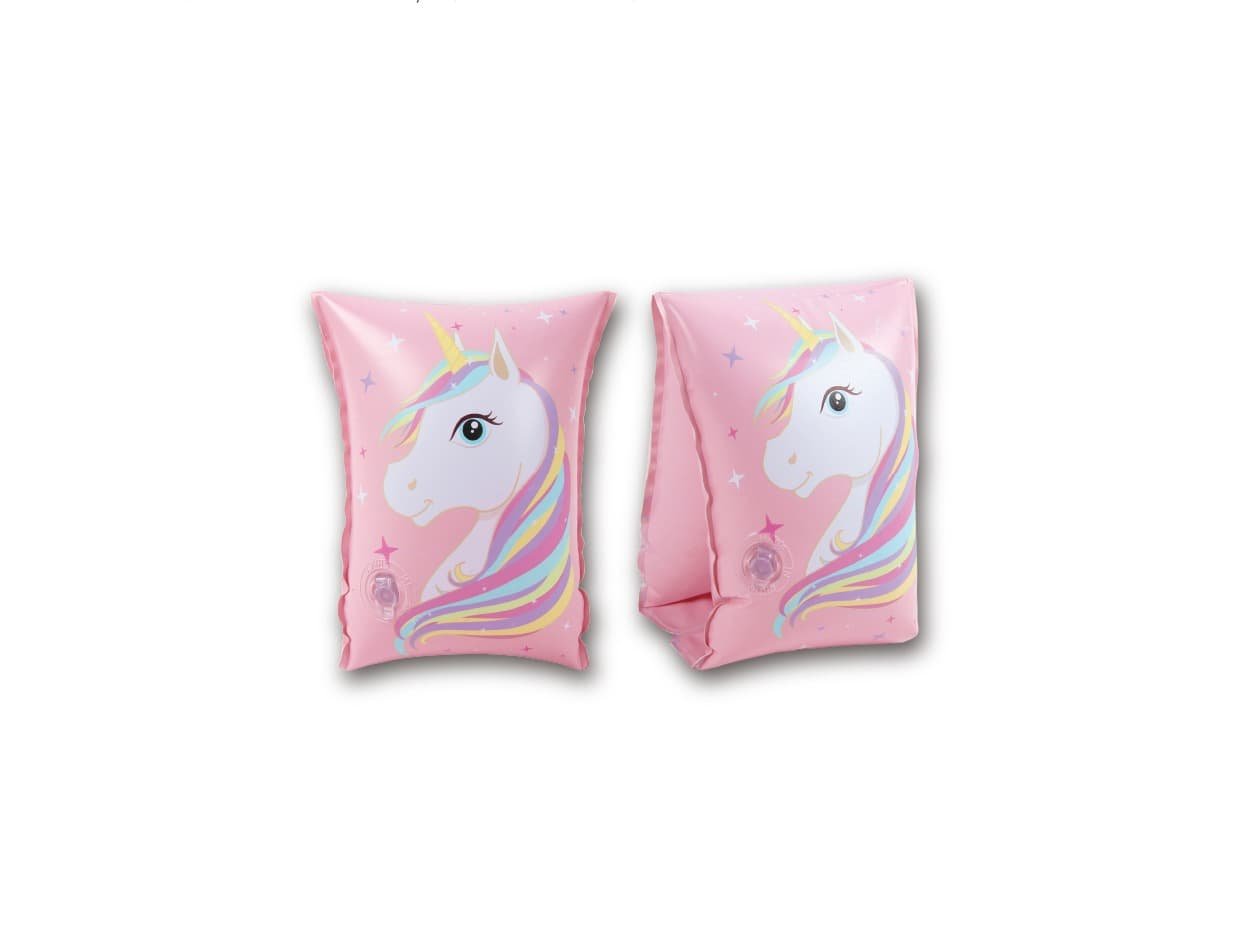
Product claims matter. Wording such as “swimming aid”, “learn-to-swim device” or “baby swim seat” can bear on classification, so intended use is worth settling during development rather than after the sample is finished.
Floating Leisure Articles: The EN ISO 25649 Series
Larger articles intended for floating leisure use can fall under the EN ISO 25649 series instead of the toy route. The series separates products into classes according to how the user interacts with them, and it sits inside the general product safety framework of Regulation (EU) 2023/988.
| Simplified memory | Typical product direction |
|---|---|
| Class A — float ON it | Lounger, floating island, giant tube, water-use air mattress |
| Class B — positioned partly IN it | Certain seated or body-opening floating articles |
| Class C — TOW it | Towable tube or towable raft |
| Class D — PLAY actively on it | Certain floating climbing, jumping or sliding structures |
| Class E — TRAVEL in it | Certain inflatable boats |
This is a simplified buyer-oriented overview. Final classification depends on the product’s intended use, user group, design and configuration.
Pools: Classification Changes With the Pool
“Inflatable”, “folding” and “frame” describe how a pool is built. They do not by themselves decide the European test route. Pool classification can depend on intended use, maximum intended water depth, wall height, effective water volume, structural configuration and other scope conditions.
- Paddling / Toy Pools → EN 71-8 direction
- Mini-Pools → EN 16927 direction
- Domestic Above-Ground Pools → EN 16582 direction
Construction alone does not determine the route. An inflatable pool, folding pool or frame-supported pool should be evaluated according to its intended use and complete product configuration.
A Tested Comparison: 366 × 120 cm Folding Pool
As a pool grows, testing moves beyond toy-related requirements into structural performance, material performance and access safety. Our non-inflatable folding pools are one example of where this applies.
A COMCO 366 × 120 cm folding pool configuration was tested by TÜV SÜD to EN 16582-1:2015+A1:2021 and EN 16582-3:2015, with PASS conclusions for the requested scope.
Test report 70.300.26.12695.02, dated 28 August 2026. Conclusions apply to the tested sample and configuration; they are not a general evaluation of other products in regular production.
Request the full test report → — the document covers the tested configuration only, so tell us the pool you are developing and we will confirm whether it applies to your program.
Resistance to bursting and permanent structural deformation.
Tear resistance and applicable material performance.
Wall-to-wall weld tensile and breaking strength where applicable.
The same report scope also covers items such as water leakage, corrosion resistance, accessibility and safety signage. Not every item applies identically to every pool construction, but each one reaches back into design: membrane specification, weld parameters, reinforcement, access design, warnings and pre-production verification.
Which Edition of a Standard Applies?
Standard editions and regulatory references do not always move at the same time. On the current EU reference list, Commission Implementing Decision (EU) 2026/901 — the list of European standards supporting Regulation (EU) 2023/988 — cites EN ISO 25649:2017 Parts 1–7. ISO has since published the ISO 25649:2024 series, but that does not automatically replace the EN ISO 25649:2017 parts the EU reference cites, and buyer protocols may follow a different timeline again. The edition should be confirmed for the specific market, product and protocol before a sample is submitted.
Standard, Buyer Protocol and Factory QC Are Different Layers
Two buyers can request different test packages for visually similar products, because a product standard is only one layer of a compliance program:
- European legal framework — statutory requirements, including the chemical restrictions of the REACH framework (Regulation (EC) No 1907/2006).
- Product classification — which route the product actually belongs to.
- Applicable product standards — the EN or EN ISO standard family for that route.
- Chemical and material requirements — applicable substance limits for the materials used.
- Buyer and retailer requirements — nominated laboratory, retailer protocol and project-specific performance items.
- Factory quality control — the manufacturer’s own process controls.
At COMCO, factory QC is its own layer, separate from regulatory compliance and retailer certification. Inflatable products undergo 100% 24-hour air-hold inspection before packing, while applicable non-inflatable and frame-pool bodies and liners undergo 100% light-table inspection to help identify pinholes, punctures and visible material defects. These are COMCO factory processes, not European legal requirements. Why quotes for the same inflatable product can differ follows the same logic.
What Helps Define the Test Route
| Information | Why it matters |
|---|---|
| Target market | Identifies the applicable regulatory framework and market-specific requirements |
| Intended user | Baby, child or adult — the user group drives age-related rules |
| Intended use | Play, swimming instruction, floating leisure or pool |
| Product configuration | Dimensions, user position, chambers, seats, handles, accessories |
| Pool configuration | Maximum intended water depth, wall height, effective volume, filtration |
| Buyer requirements | Nominated laboratory and retailer protocol, where applicable |
Defining these inputs early can reduce reclassification, redesign and repeat testing later in development — and it is why we start every project in product development rather than at the laboratory.
Frequently Asked Questions
Do all inflatable water products in Europe require EN 71?
No. The route depends on product classification and intended use. Aquatic toys can fall within the toy-safety framework, while swimming learning devices, floating leisure articles and larger pools follow different safety routes.
How do I know which European standard applies to my product?
Start with what the product is, who it is intended for and how it is used. Those answers place it in a route — aquatic toy, swimming learning device, floating leisure article or pool — and the route points to the standard family. The applicable edition and the exact test scope are then confirmed for the specific product with the nominated testing laboratory.
Can inflatable, folding and frame pools follow different testing routes?
Yes. Inflatable, folding and frame describe how a pool is built, not what it is classified as. A paddling pool, a mini-pool and a domestic above-ground pool can sit in different standard frameworks even when they look similar, so the route follows the intended use and the complete product configuration.
Why can two retailers request different tests for similar products?
The applicable product standard is only one layer. Target-market requirements, chemical and material requirements, labeling, retailer protocols and project-specific performance requirements can all change the package.
Related reading: our U.S. Compliance Guide for Inflatable Toys, Pool Floats & Inflatable Pools applies the same classification-first logic to the American market.
Developing a Water Product for the European Market?
Share your product concept, reference design, intended user, target dimensions and destination market. COMCO can review the manufacturing requirements with your team and coordinate product development with the applicable testing plan.
Resources
Related articles

Compliance & Testing · October 3, 2026
U.S. Compliance Guide for Inflatable Toys, Pool Floats & Inflatable Pools
Understand U.S. compliance considerations for inflatable toys, pool floats and inflatable pools, including ASTM F963, ASTM F2666, children's product requirements and retailer testing protocols.
Compliance & Testing · September 26, 2026
What Happens Before Mass Production?
See how COMCO validates inflatable products before mass production through first-sample checks, physical testing, inflation observation and process adjustment.