采购指南与行业洞察
How to Choose an Inflatable Pool Manufacturer: A Buyer’s Guide
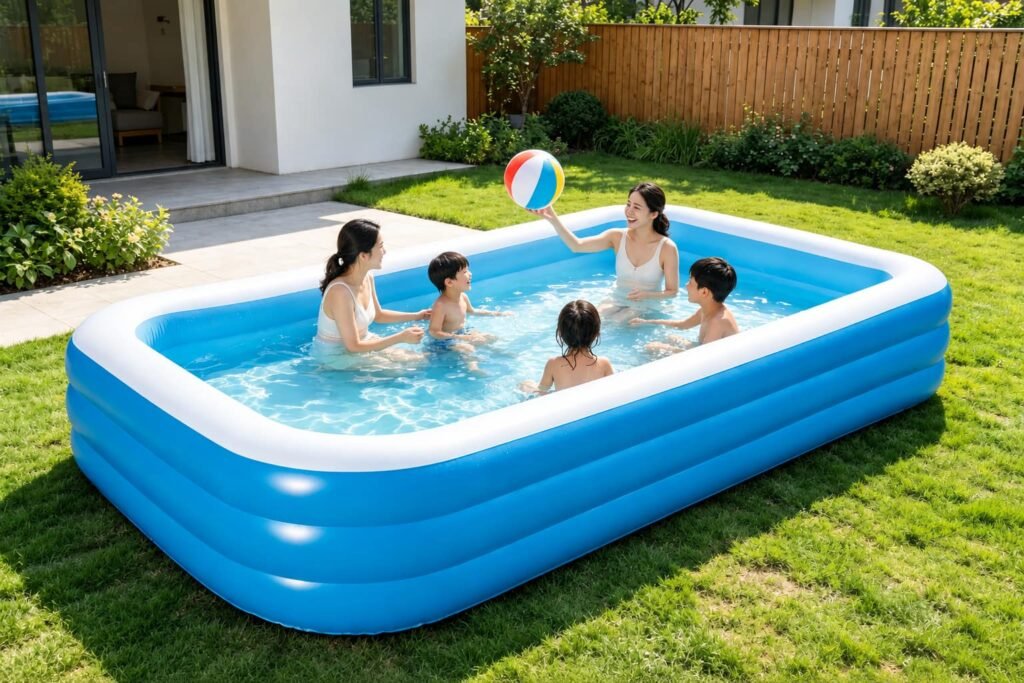
Choosing an inflatable pool manufacturer is not only about finding the lowest quotation or the thickest PVC.
A suitable supplier needs to be able to make the type of product you need, turn your requirements into a production-ready specification, control the manufacturing process, validate quality, and reproduce the approved product consistently at scale.
For brands, importers and retailers, the goal at the early sourcing stage is not to perform a full factory audit yourself. It is to determine whether a manufacturer appears capable of supporting your product and is worth moving forward with for an RFQ, sample or development project.
→
2. Development
→
3. Material
→
4. Manufacturing
→
5. Quality
→
6. Commercial Fit
→
RFQ / Sampling
Here are the ten areas that matter most when evaluating an inflatable pool manufacturing partner.
1. Start with Product Fit
The first question is simple:
“Does this manufacturer regularly make products similar to the one you want to source?”
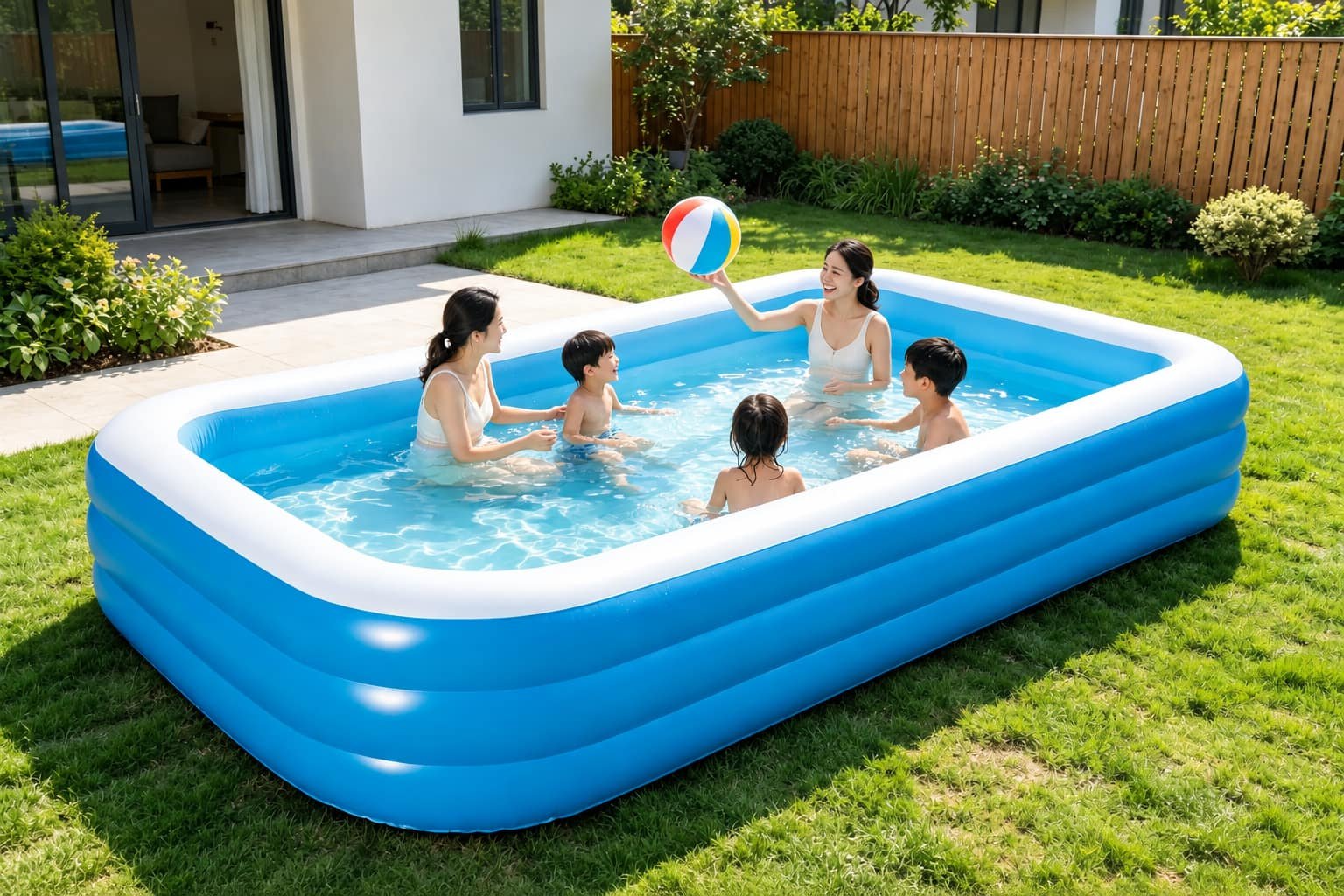
“Inflatable products” is a broad category. A supplier that mainly makes promotional beach balls or seasonal novelties may not have the same manufacturing experience as one producing inflatable family pools, water-play centers, pool lounges or heavy-duty air mattresses.
For an inflatable pool program, relevant manufacturing experience typically includes:
- Inflatable family pools and kids paddling pools
- Water-play centers with integrated sprayers and slides
- Pool floats and swim aids
- Multi-chamber PVC closed-air structures
- Precision high-frequency (HF) welded seams
- Products engineered for major retail programs and international brand standards
Why it matters: A manufacturer already familiar with pool hydrostatic loads and chamber stresses is far more likely to understand the material, seam design, welding parameters, valve placement, printing resistance and production stability required.
At COMCO, pools and water-play products are core product groups rather than occasional projects.
2. Look Beyond “Can You Customize?”
Most OEM manufacturers will automatically answer “yes” when asked whether they can customize a product.
The more revealing test is what happens after you send a sketch, tech pack, 3D model, reference sample or defined product concept.
A capable OEM product development process should be able to transform customer input into practical production decisions, such as:
- Precise inflated vs. deflated cut dimensions
- Chamber layout, internal baffle design and seam lines
- Appropriate PVC specification and formulation
- Silk screen or roller printing methods and color fastness
- Safety valve selection and ergonomic placement
- Grip handle, drain plug and accessory integration
- Retail gift box, polybag and master carton specifications
- Manufacturing feasibility and cost optimization
For complex products, a clear concept or basic design direction is still necessary. Product development is a collaboration between the buyer’s market direction and the manufacturer’s engineering experience. To see each development phase from initial artwork to approved pre-production golden sample, explore how an OEM inflatable product is developed.
COMCO supports OEM and ODM development from sketches, drawings, reference products and defined concepts, helping turn them into production-ready specifications.
3. Understand How Material Specifications Are Decided
PVC thickness is easy to compare on a quotation sheet, but it should never be treated as an isolated quality grade.
As explained in our technical analysis on how PVC specifications should be selected, the appropriate material specification depends on multiple interrelated factors:
- Product size and inflated surface area
- Chamber architecture and internal support structure
- Intended use and user age group
- Water volume load and hydrostatic wall pressure
- Seam layout and HF welding geometry
- Quality expectations and durability targets across seasons
- Retail positioning and packaging constraints
- Target FOB cost direction
For example, a lightweight toddler paddling pool and a large rectangular family pool holding over 1,000 liters of water should never use the same material specification.
A capable manufacturer should be able to explain why a proposed PVC specification fits the product’s structure and performance needs, rather than simply marketing thicker film as generic “premium quality.”
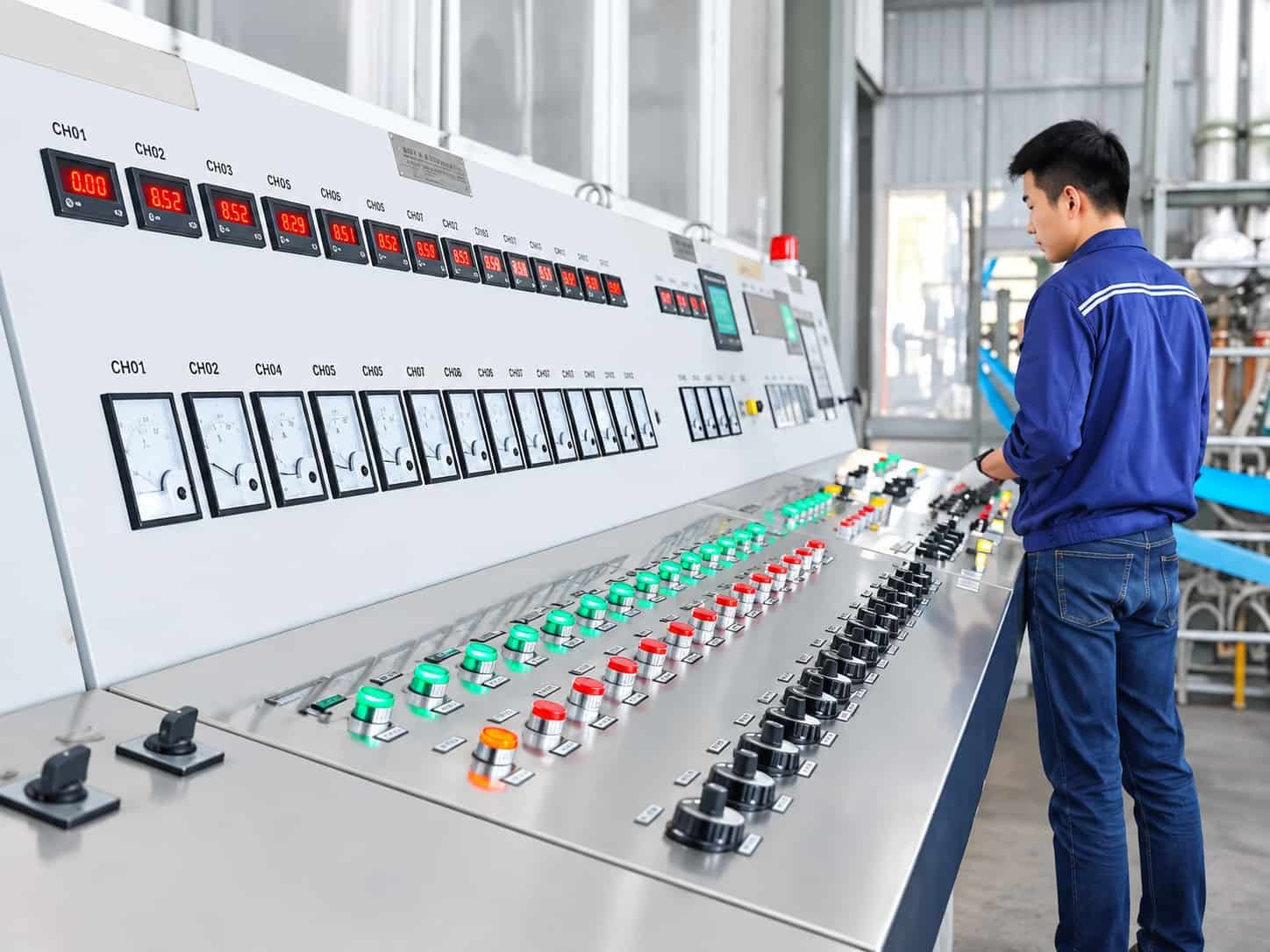
COMCO operates in-house PVC film production, allowing material formulation and thickness calendering to be directly coordinated with downstream inflatable pool manufacturing.
4. Evaluate the Manufacturing Process, Not Just the Equipment List
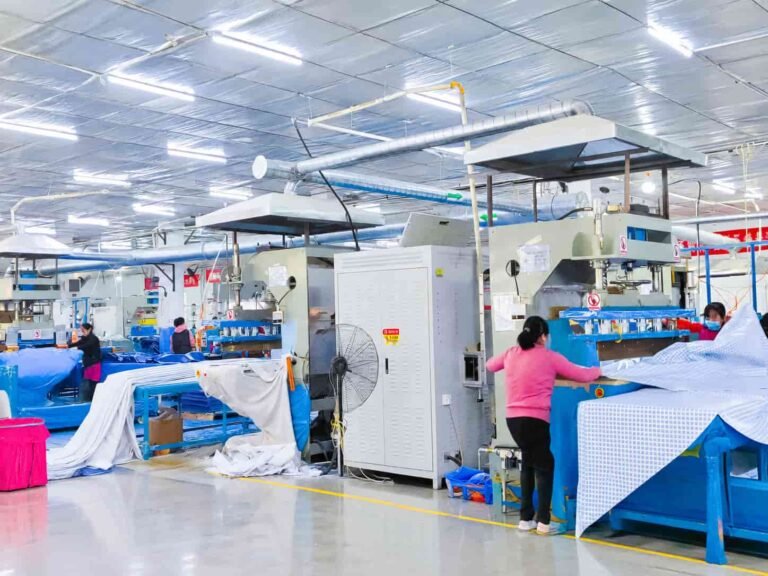
Owning high-frequency welding machines does not by itself prove that a factory can consistently produce a leak-free inflatable pool.
The finished pool depends on an integrated, tightly controlled sequence. To understand every stage from polymer resin to boxed shipping containers, read our comprehensive overview of the inflatable product manufacturing process.
Depending on the product, that process includes:
PVC Film Calendering → Pattern Printing → Precision Cutting → HF Welding → Accessory Assembly → Inflation Inspection → Packing
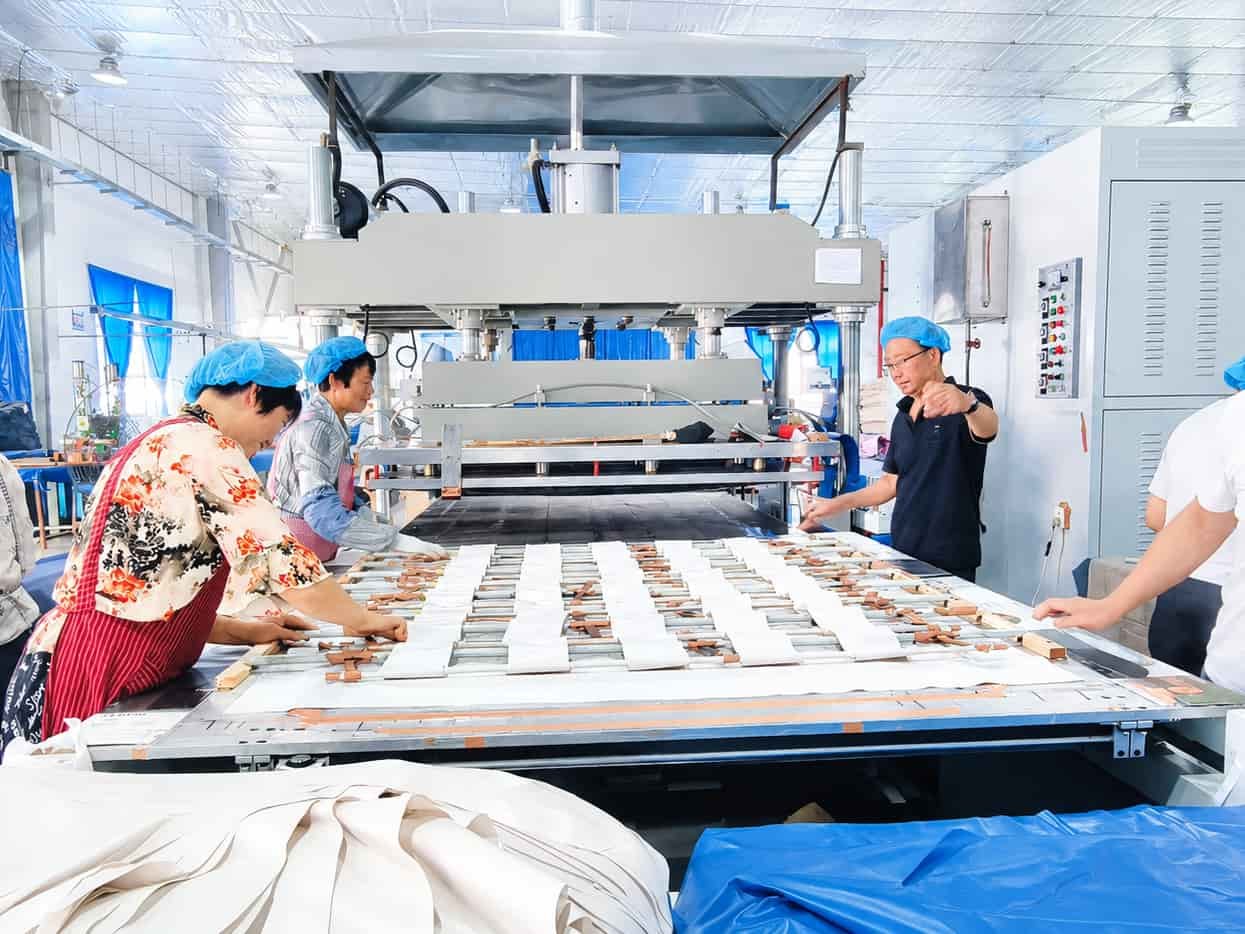
Critical manufacturing factors include:
- Raw material surface consistency and dielectric response
- Brass electrode precision and mechanical alignment
- Welding energy, pressure, temperature and cycle time calibration
- Overlap margins and corner stress relief
- Safety valve and drain plug hermetic sealing
- In-line process monitoring across operational shifts
The essential sourcing question is not whether the factory owns machinery, but whether your product will pass through a disciplined, repeatable production process.
5. Understand How Quality Is Built Before Mass Production
Final pre-shipment inspection is essential, but quality control should never begin after thousands of units have already rolled off the line.
Before mass production starts, production-intent pilot pieces should be used to validate whether the material, seam geometry, tooling alignment and assembly steps function together reliably. Learn more about COMCO’s engineering protocols for pre-production quality validation.
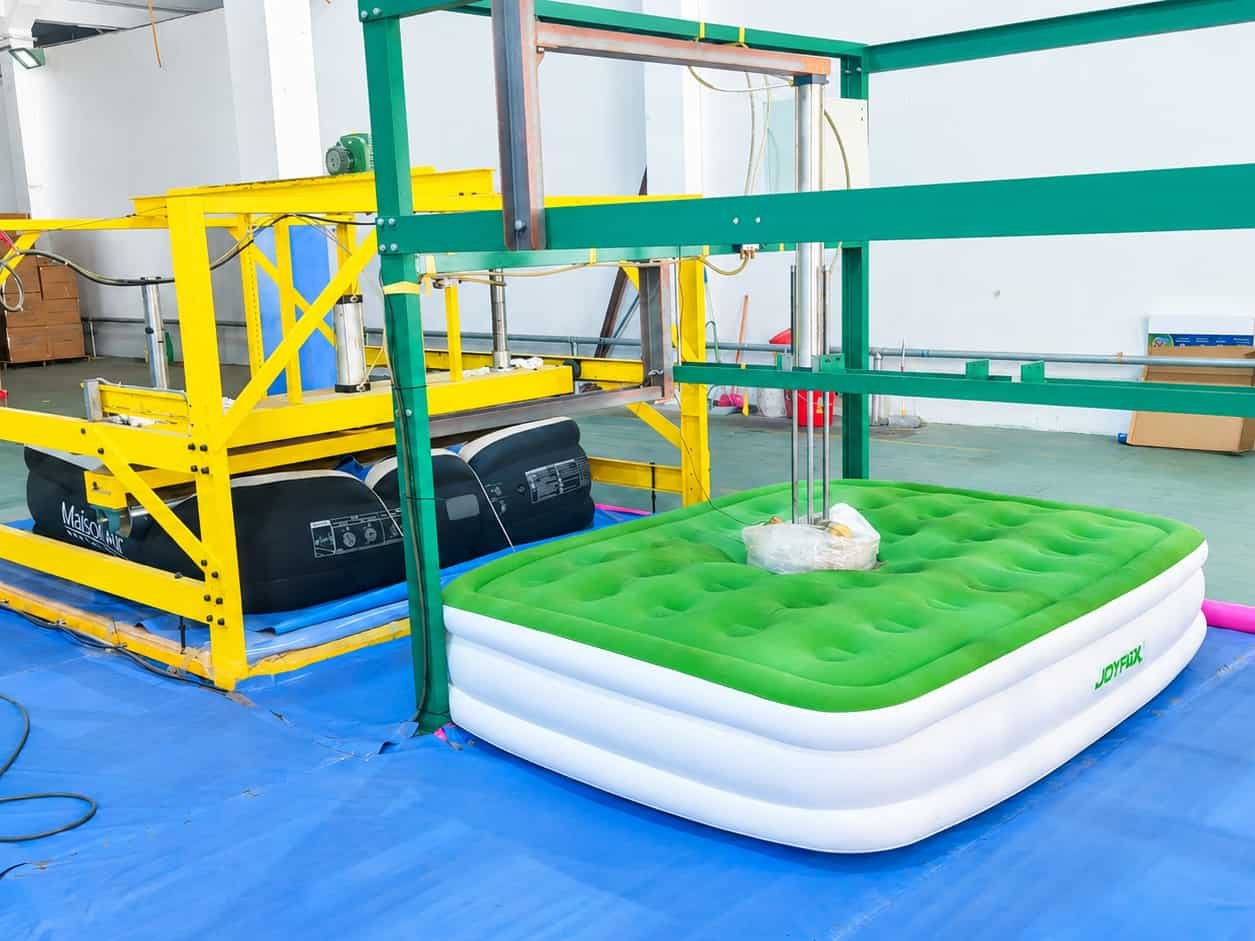
Depending on the pool model, validation may include:
- Dimensions, shape stability and print registration
- Seam peel strength and tensile burst testing
- Valve retention and drain plug sealing
- Repeated inflation and rapid deflation cycles
- Hydrostatic water-holding and sidewall bulge observation
- 24–48 hour air-retention observation for applicable products
As detailed in Why Inflatable Products Leak: How Factories Control Leakage Before Mass Production, slow leaks take time to detect. If an issue appears during validation, the true mark of a reliable manufacturer is its ability to identify the root cause, adjust tooling or welding parameters, and revalidate before releasing the line.
A Strong Quality Model: Validate → Identify Risk → Correct Root Cause → Re-validate → Control During Production
6. Check Experience with Your Target Market and Product Requirements
An inflatable pool distributed in North America, the European Union, Australia or Japan faces distinct safety, chemical, labeling and physical testing standards.
At the early supplier-selection stage, buyers do not need to perform a full compliance audit before initiating dialogue. What matters is whether the manufacturer has demonstrated experience in your target market and understands that regulatory requirements must be confirmed for the specific product configuration.
Useful early indicators include:
- Track record supplying products for your destination markets
- Familiarity with third-party testing protocols (e.g., EN 71, ASTM F963, ISO 25649, CPSIA, REACH phthalate restrictions)
- Experience adapting to buyer-specific quality manuals
- History supporting major retailer or brand compliance programs
- Ability to provide relevant audit or compliance documentation during formal qualification
COMCO has substantial experience manufacturing products for major international markets and collaborating with accredited third-party laboratories. Specific testing protocols and chemical limits should always be confirmed based on the product’s classification, intended age group and destination jurisdiction.
7. Check MOQ, Sampling and Customization Flexibility
A supplier may possess advanced technical capability but still prove a poor operational fit if their Minimum Order Quantity (MOQ) or development model does not match your procurement strategy.
Before investing extensive development resources, clarify:
- Standard production MOQ per style/colorway
- Whether MOQ varies between standard catalog molds and new custom tooling
- Sample development lead times for initial prototypes
- Sampling costs and refund terms against production orders
- Information required to start sampling (die-lines, 3D files, color references)
- Prototype revision process and turnaround times
For COMCO, production MOQ is commonly in the 3,000–5,000 pieces per style range, depending on pool size, material specification and project scope.
Standard pool structures with custom artwork can often be sampled rapidly, whereas completely custom geometric shapes, new chamber architectures or specialized valves require dedicated tooling preparation.
8. Consider Capacity and Lead Time Early
An inflatable pool factory may deliver an excellent sample in October, yet struggle to ship mass production volume during the seasonal manufacturing peak between January and April.
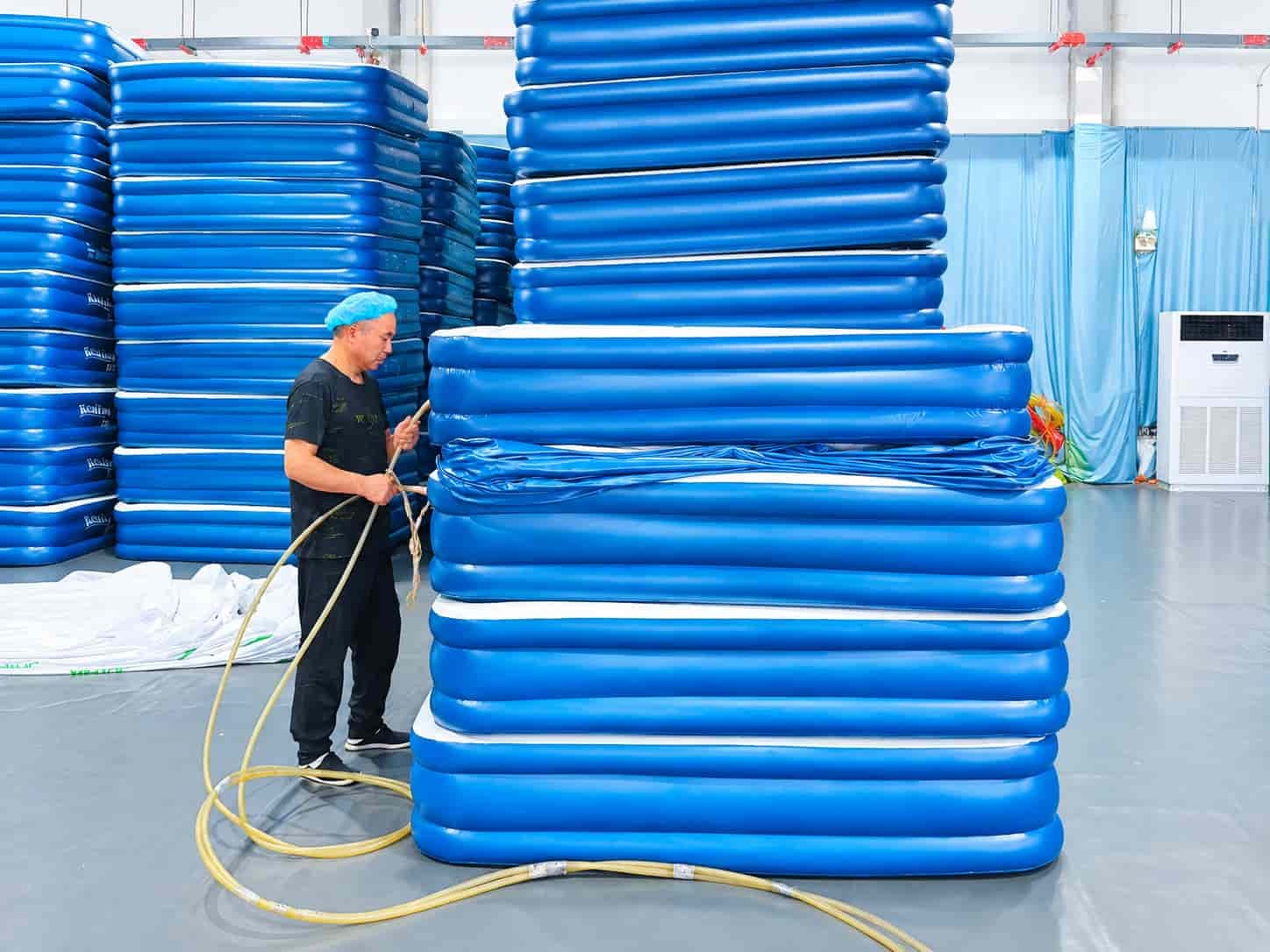
Early capacity reviews should assess:
- Total projected order quantity and SKU breakdown
- Required port delivery window and container booking deadlines
- Packaging complexity (e.g., custom printed display cartons, inserts)
- Peak-season production floor allocation
- Sample approval and artwork finalization cut-off dates
COMCO operates multiple manufacturing facilities and production lines dedicated to inflatable and outdoor leisure products. Under normal scheduling, production lead time after final sample confirmation is typically around 45–60 days, while peak-season programs require advance production planning.
Lead times should always be reconfirmed for the specific product specification and order timeframe.
9. Compare Quotations on the Same Product Specification
Two quotation sheets for what appears to be the same inflatable pool can look remarkably similar while representing completely different product realities.
Before comparing unit FOB prices, ensure that competing proposals are built on identical, transparent specifications:
- Dimensions: Inflated outer dimensions vs. flat uninflated pattern size
- PVC specification: Film thickness, resin quality and cold-crack additives
- Chamber design: Independent ring chambers vs. single-chamber walls
- Printing: Number of colors, ink coverage area and surface varnish
- Valves & plugs: Quick-deflation valves vs. basic pinch valves, drain plug presence
- Accessories: Repair patches, grab handles, warning labels
- Packaging: Corrugated carton ply, cardboard weight and color box coating
- Testing requirements: Included third-party lab test assumptions
- Commercial terms: Order volume tiers and FOB port delivery terms
A lower quotation frequently reflects a lighter material gauge, narrower seam margins, basic packaging or omitted testing costs. The productive sourcing question is never simply “Who has the lowest price?” — it is “What exact product specification is included in this price?”
10. Evaluate Communication and Problem-Solving
How a factory communicates during initial quotation and prototype development is the single best predictor of how they will manage production when challenges arise.
A true manufacturing partner contributes engineering value beyond quoting a drawing. During early interactions, observe whether the supplier:
- Quickly grasps the intended product function, user demographic and market context
- Identifies missing technical dimensions or contradictory requirements in the tech pack
- Explains material, chamber or seam recommendations with clear engineering reasoning
- Flags potential welding or air-retention risks before mold fabrication begins
- Offers practical value-engineering options to achieve a target retail price
- Maintains transparent, structured quotations and detailed revision logs
Once your product direction is clearly established, a capable manufacturer should provide practical production insight that helps you de-risk the product before mass production begins.
A Practical Early-Stage Checklist
When shortlisting inflatable pool manufacturers, the initial evaluation can stay focused and structured:
| Evaluation Area | What You Are Trying to Understand |
|---|---|
| Product Fit | Do they regularly produce inflatable pools and closed-air water-play products? |
| Development | Can they turn sketches or tech packs into production-ready patterns and tooling? |
| Material | Can they explain why the proposed PVC specification matches the pool’s structure and load? |
| Manufacturing | Is there a disciplined HF welding and assembly process behind the machinery? |
| Quality | How is the pool validated before production and inspected via air retention during production? |
| Market Experience | Do they understand the compliance and testing expectations of your destination market? |
| MOQ & Sampling | Does their minimum order volume and sampling workflow fit your commercial scale? |
| Capacity | Can they support your required peak seasonal volume within your required delivery window? |
| Quotation | Are competing quotes based on identical dimensions, materials, packaging and test scope? |
| Communication | Do they proactively solve engineering issues and keep specifications transparent? |
You do not need to perform every detailed factory audit step before deciding whether to request a quote or initiate prototyping. At this early stage, the objective is to answer one central question:
“Does this manufacturer demonstrate the technical capability, engineering process and production discipline needed to develop, produce and control our inflatable pool program?”
If the supplier demonstrates those capabilities, detailed testing protocols, factory audits and final commercial terms can follow smoothly during later qualification phases.
Frequently Asked Questions
What should I look for in an inflatable pool manufacturer?
Focus on verified product experience with pools, engineering development capabilities, PVC material knowledge, high-frequency welding discipline, pre-production quality validation, experience in your target market, realistic MOQs, seasonal capacity and quotation transparency.
Is thicker PVC always better for an inflatable pool?
No. PVC thickness must be evaluated together with pool dimensions, chamber design, water volume load, seam structure, folding flexibility and cost. A thicker material alone cannot compensate for poor seam welding or weak structural design.
Can an inflatable pool manufacturer develop a product from a sketch?
Yes, provided the sketch or concept establishes clear dimensions, general shape and functional intent. The manufacturer’s engineering team can help translate the concept into 2D cut patterns, chamber layouts, valve placements and tooling designs.
What is a typical MOQ for custom inflatable pools?
MOQ varies based on product size, custom colorway formulation and packaging complexity. At COMCO, common production MOQs are between 3,000 and 5,000 pieces per style, depending on the project.
How long does inflatable pool production take?
Standard mass production lead time after golden sample approval is typically 45 to 60 days. Peak season programs (shipping prior to summer retail windows) require advance capacity booking and earlier artwork sign-offs.
Should I choose the inflatable pool supplier with the lowest price?
Only if the quotation is verified to match the exact same material formulation, thickness, chamber construction, print coverage, packaging standards and testing scope. Lower quotes frequently hide omitted specifications or thinner film that could lead to field failures.
Looking for an Inflatable Pool Manufacturing Partner?
If you are evaluating a new inflatable pool program, developing a custom design or qualifying an additional supplier, send us your reference drawings, target dimensions, intended market, order volume and target delivery window. COMCO can review your product direction and provide manufacturing feasibility, material recommendations and a transparent quotation.
资源中心
相关文章
采购指南与行业洞察 · 28 9 月, 2026
Does Thicker PVC Mean a Better Inflatable Product?
Does thicker PVC always …